
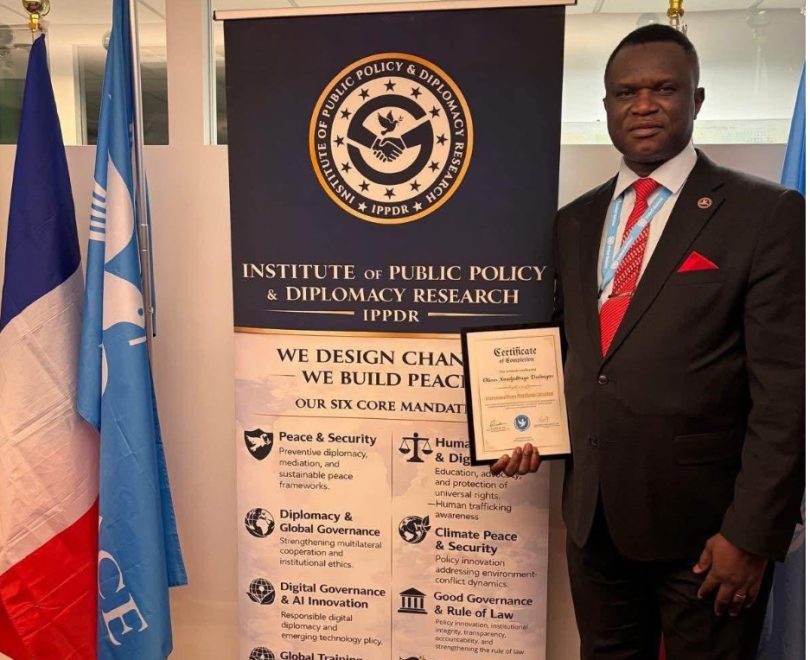

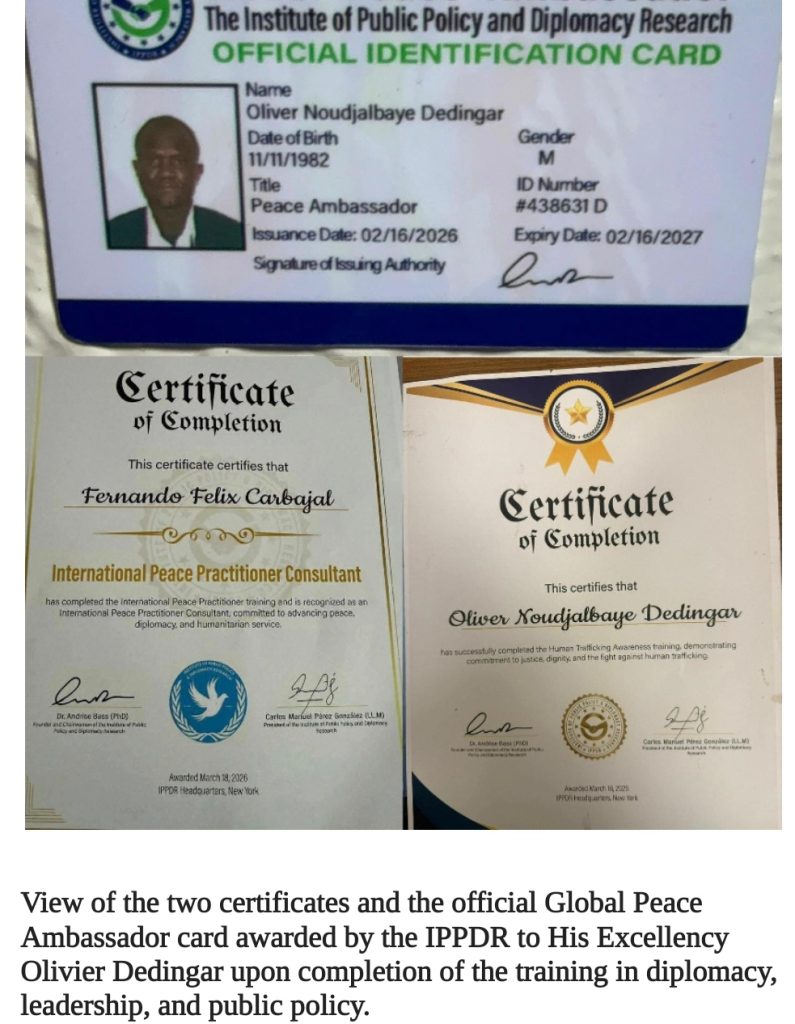
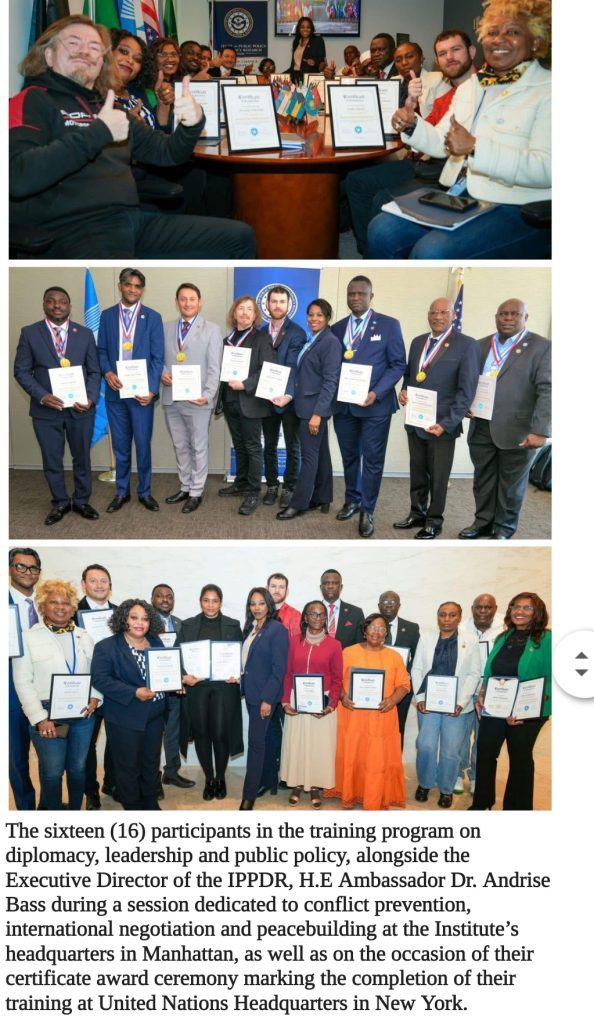
In a significant step toward strengthening Africa’s voice in global peacebuilding and diplomacy, His Excellency Olivier Noudjalbaye Dedingar has been officially recognized as Global Peace Ambassador following the successful completion of the prestigious International Peace Practitioner and Global Peace Ambassadors Training, organized by the Institute of Public Policy and Diplomacy Research. The high-level program was held from March 17 to March 19, 2026, at the institution’s headquarters in New York, bringing together an elite cohort of emerging and established leaders from across the world, based on recommendations and a highly rigorous and selective recrutment process.
This appointment is more than a personal distinction ; it represents a strategic investment in Africa’s leadership capacity at a time when the continent is redefining its role within an increasingly complex global order. As geopolitical dynamics shift and new centers of influence emerge, Africa’s need for skilled, ethical, and globally competent leaders has never been more urgent.
A Training Ground for Global Leadership.
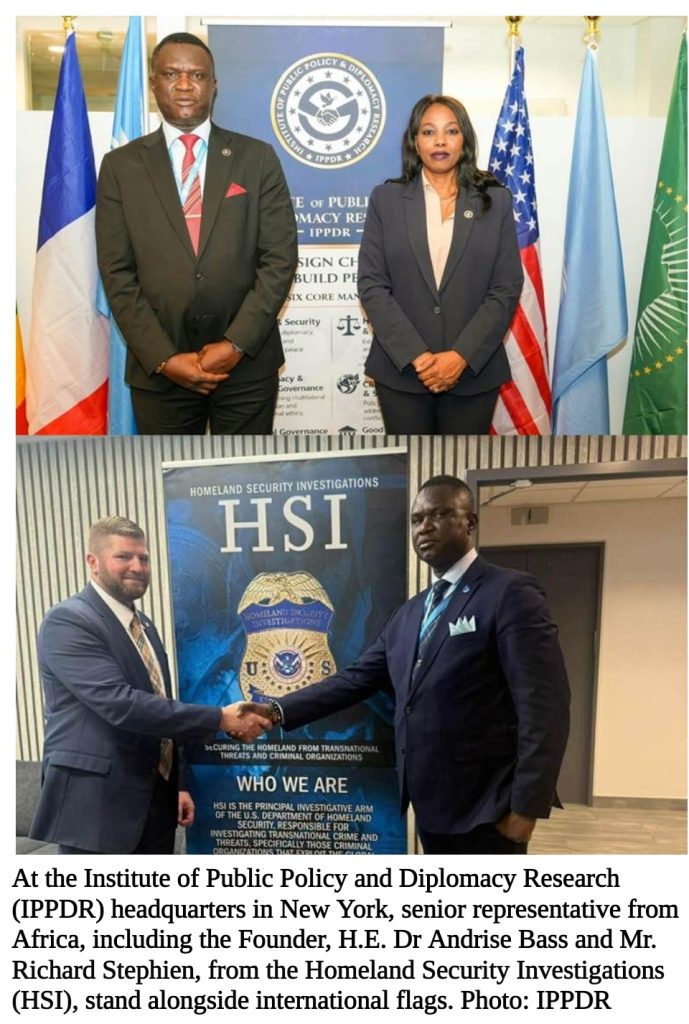
The intensive three-day masterclass was designed to equip participants with practical and strategic competencies in international affairs, diplomacy, conflict prevention, negotiation, and peacebuilding. Under the leadership of H.E. Ambassador Dr. Andrise Bass, Executive Director of IPPDR, the program combined academic rigor with real-world simulation, reflecting standards aligned with multilateral institutions such as the United Nations.
Day one focused on international affairs and diplomacy, laying a foundation for understanding global governance systems and diplomatic engagement. Day two addressed one of the most pressing humanitarian challenges of our time : human trafficking through expert-led sessions that explored legal frameworks, prevention strategies, and policy responses. The session was conducted by Mr. Richard Stephien, Supervisory Special Agent with Homeland Security Investigations (HSI).
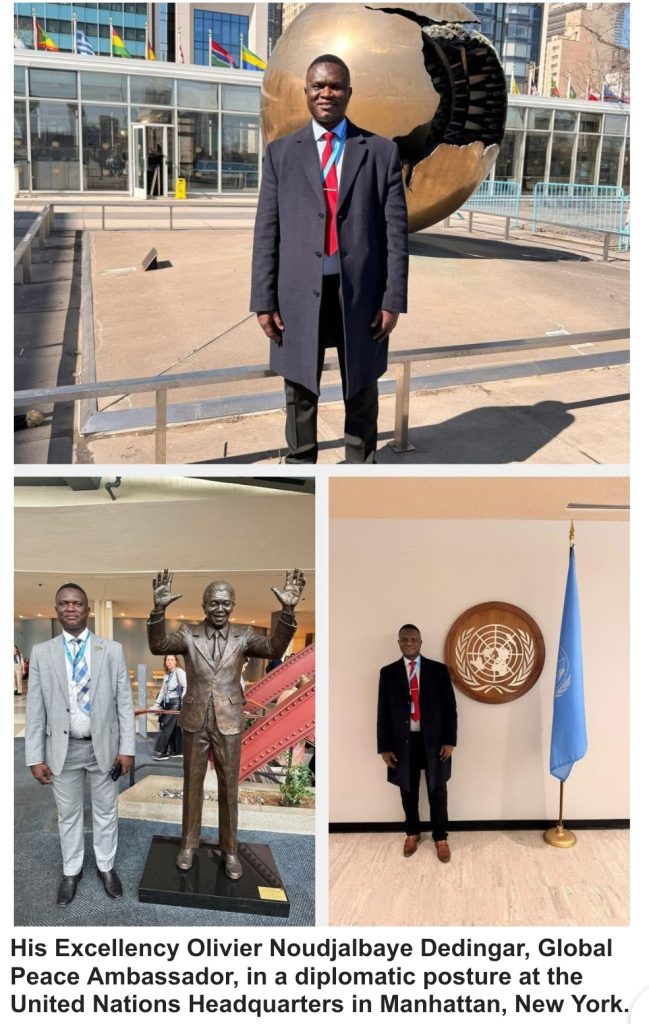
The day culminated in a diplomatic luncheon and certification ceremony held at the United Nations Headquarters Delegates Dining Room, symbolizing the program’s alignment with global institutional excellence.
On the final day, participants engaged in advanced training in conflict prevention, peacebuilding and international negotiation, including a high-level simulation on U.S.–Iran relations and the strategic importance of the Strait of Hormuz. This exercise required participants to navigate complex geopolitical tensions, balancing sovereignty, economic interests, and global security skills essential for modern diplomacy.
A Global Cohort, A Shared Vision.
The program convened 16 participants from diverse countries including the United States, Chad, Senegal, Ghana, Ivory Coast, Benin, Haiti, Argentina, Ukraine, Guyana, Trinidad and Tobago, Jamaica and Russia. Representing a wide range of professional backgrounds : government advisors, legal experts, former diplomats, religious leaders, and public figures. The cohort embodied the interdisciplinary and multicultural approach required for effective global leadership.
H.E. Olivier Noudjalbaye Dedingar from the Republic of Chad, distinguished himself not only through active participation, informed by his professional experiences as a diplomat, lawyer, reserarcher and journalist but also through intellectual leadership, notably contributing to the official meeting records of the negotiation simulation. His recognition as both an International Peace Practitioner Consultant and Global Peace Ambassador underscores his commitment to advancing diplomacy, justice, human rights, international security, humanitarian service and sustainable development goals.
Africa at the Center of Global Transformation
This achievement carries particular significance within the African context. As the continent faces critical challenges including governance reform, security threats, climate change, youth unemployment, gender based violences, and institutional development, there is a growing recognition that sustainable progress depends on leadership grounded in competence, ethics, and global awareness.
Programs such as those offered by IPPDR are instrumental in bridging the gap between local realities and global frameworks. They empower African leaders to engage effectively on the international stage while driving transformative change within their own countries.
H.E. Dedingar’s appointment reflects this emerging paradigm: a new generation of African leaders equipped not only with academic credentials but also with practical diplomatic experience and a clear commitment to peacebuilding.
A Forward-Looking Commitment.
In an era defined by uncertainty and interconnected challenges, the role of Global Peace Ambassadors is both timely and essential. Their mandate extends beyond advocacy and simple representation; it involves active engagement in conflict resolution, couterterrorism, policy dialogue and the promotion of SDGs and inclusive governance.
For H.E. Olivier Dedingar, this recognition marks the continuation of a broader journey, one that integrates legal and scientific expertise, international engagement, and a deep commitment to justice and human dignity. It also reinforces the importance of continuous professional development, particularly in the context of transnational leadership pathways and global citizenship.
‘’As I formally step into my role as a Global Peace Ambassador, I do so with humility and a profound sense of responsibility. I remain committed to upholding the highest standards of integrity, to listening with empathy, and to contributing constructively to the promotion of peace, dialogue, and inclusion across our international community’’ he said after his appointment.
The appointment of H.E. Olivier Dedingar as Global Peace Ambassador stands as a powerful testament to the importance of investing in human capital, particularly within Africa’s evolving leadership landscape. It signals a future where African voices are not only heard but are actively shaping global peace, governance agendas and inclusive development.
As Africa rises, so too must its leaders equipped, empowered, and prepared. This moment is not just a recognition of achievement; it is a call to action for a continent poised to lead.
Written by Dr. Florence Omisakin (PhD).