
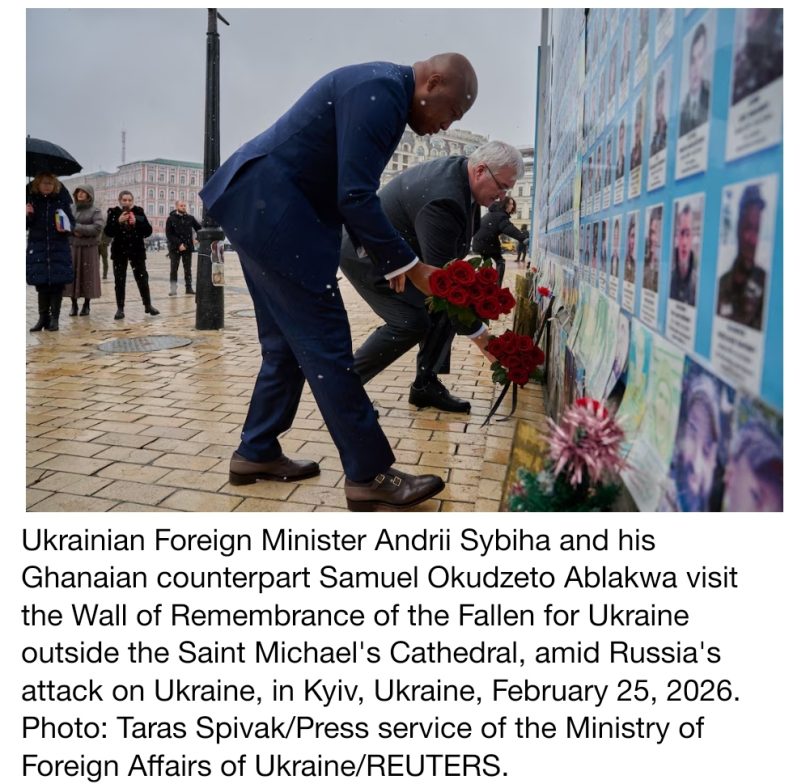

Ghana’s foreign affairs minister says at least 55 of the country’s citizens have been killed fighting for Russia in its war in Ukraine. Samuel Okudzeto Ablakwa announced during a visit to Kyiv, where he held talks with Ukrainian officials, about two Ghanaian nationals currently being held as prisoners of war.
He said Ukrainian authorities had informed him that about 272 Ghanaians are believed to have been recruited into the conflict since Russia’s full-scale invasion of Ukraine in February 2022.
Describing the figures as “depressing and frightening”, Mr Ablakwa said Ghana “cannot turn a blind eye to these heartbreaking statistics”.
“This is not our war, and we cannot allow our youth to become human shields for others,” he added.
Prisoners of war
During the visit, Mr Ablakwa met with Volodymyr Zelensky and other Ukrainian officials to discuss the fate of the two detained Ghanaians, who were captured while fighting for Russia.
He urged President Zelensky to facilitate their release, describing the men as “victims of manipulation, of disinformation, misinformation, of criminal trafficking networks”.
Mr Ablakwa said Ghana had received assurances that the two detainees were being treated in accordance with international law.
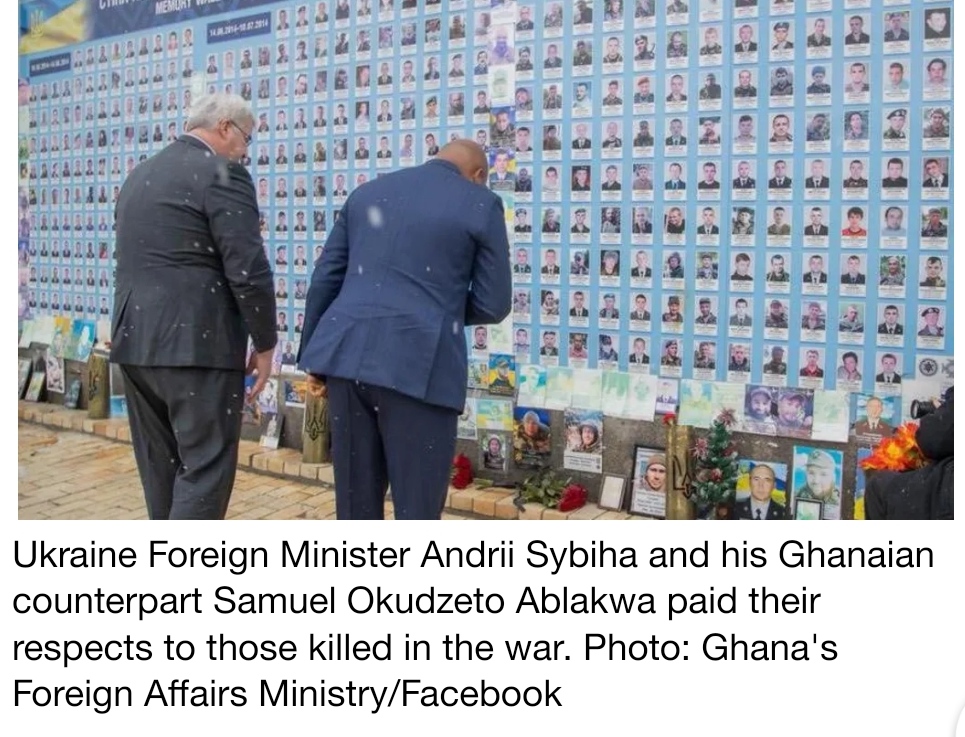
“We have received reports that they are in good health,” he said. “They have not been tortured. They have not suffered any inhumane treatment since they were captured.”
Ukraine has repeatedly warned that foreign nationals fighting on Russia’s side would be treated as enemy combatants, but says those who surrender are handled as prisoners of war under international humanitarian law.
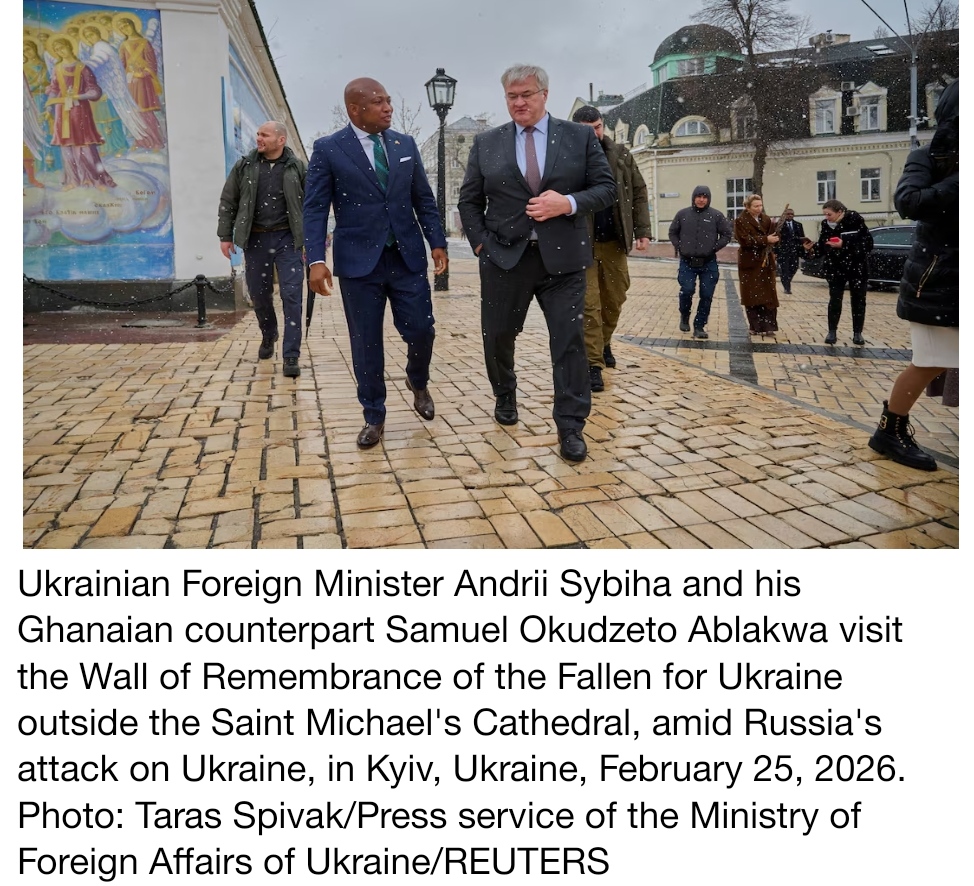
Ukraine’s foreign minister, Andriy Sybiga, said discussions with Ghana were “frank”, including talks about the possibility of returning the detainees.
Recruitment concerns
Mr Ablakwa said the 272 Ghanaians believed to have been drawn into the conflict since 2022 were recruited through what he described as illegal networks.
He said the government was committed to “tracking and dismantling all dark web illegal recruitment schemes” and would launch public awareness campaigns to discourage young people from travelling abroad under false promises of employment.
Several African governments have in recent months raised concerns that their citizens were promised lucrative civilian jobs in Russia, only to be required to sign military contracts and deployed to the front lines with limited training.
On Wednesday, Mr Sybiga said nearly 1,800 people from 36 African countries had been recruited to fight for Russia.
Russia has denied illegally recruiting African nationals. Its embassy in Kenya has previously said that while it was not involved in recruitment drives, Russian law permits foreign nationals who are legally in the country to enlist in the armed forces voluntarily.
Regional dimension
The 55 Ghanaian deaths represent the highest number of casualties from a single African country to have been officially confirmed in the war.
Local media in Cameroon have reported that 94 of its nationals have died in the conflict, though authorities there have not confirmed the figure.
In South Africa, Foreign Minister Ronald Lamola said on Thursday that two South Africans had been killed in Ukraine. He added that 15 others had been repatriated over the past week, while two more remained in Russia receiving treatment for severe injuries.
At least one Kenyan has also been reported killed. On Thursday, a Kenyan national, Festus Arasa Omwamba, appeared in court charged with luring young men to Russia with promises of employment, only for them to be sent to fight in Ukraine. He denied the charges.
A recent report by Kenya’s National Intelligence Service said around 1,000 Kenyans had been recruited to fight for Russia in its four-year war against Ukraine.
The International Crisis Group said in a report published on Friday that the growing number of African casualties highlighted how the conflict was increasingly affecting governments far beyond Europe.
“The recruitment scandal makes clear that the Ukraine war is no longer a distant geopolitical issue for African governments,” it said. “As their citizens become directly entangled in the conflict, leaders could face mounting domestic pressure that makes it more difficult to stick to principles of nonalignment.”
A family waiting
For families, the impact has been deeply personal.
According to a news agency, 35-year-old Joshua Nkrumah left his pregnant wife in Dubai in July 2024 after being offered what he believed was a private security job in Russia. He was captured by Ukrainian forces in September after surviving a drone strike and has remained in detention since.
His family says they have not had direct contact with him.
His father, Albert Nkrumah, told the agency he often wondered whether his son was alive.
“As a father, I live every day with a silent weight on my chest. I wake up, and the first thing I think about is my son, whether he has eaten, whether he is safe, whether he still has hope,” he said. “I just want my son alive and back home. That is all a father asks.”
Broader questions
The war, which began with Russia’s full-scale invasion of Ukraine in February 2022, has drawn in foreign fighters on both sides. Ukraine has also faced criticism in the past over efforts to recruit foreign nationals to join its forces.
However, Ukrainian officials say anyone fighting for Russia is considered an enemy combatant under the laws of war.
Mr Ablakwa said Ghana would continue diplomatic engagement to secure the safe return of its detained nationals and prevent further recruitment.
“We cannot allow our youth to become human shields for others,” he said.