


The first week of the 30th UN Conference of the Parties (COP30) in Belém, Brazil, was a maelstrom of stark warnings, procedural paralysis, and profound cultural conflict.
Billed by its host, President Luiz Inácio Lula da Silva, as the “Cop of truth,” the summit’s opening days immediately crash-tested high-stakes rhetoric against the unyielding wall of geopolitical reality.
As delegates gathered near the mouth of the Amazon, the week (November 10-14) was defined by three overwhelming narratives: the existential, apocalyptic warnings from global leaders; the “jaw-dropping” vacuum left by an absent United States; and a tense, escalating “inside-outside” conflict between the summit’s officialdom and the very Indigenous peoples this “Amazon COP” was meant to champion.
By Friday, with core negotiations hopelessly deadlocked, the Brazilian presidency had resorted to asking delegates for “love letters” in a desperate bid to turn stalemate into “therapy.” It was a surreal end to a week that began with accusations of “deadly negligence.”
Day 1. The ‘Red Line’ and the ‘Slide Show of Horrors’
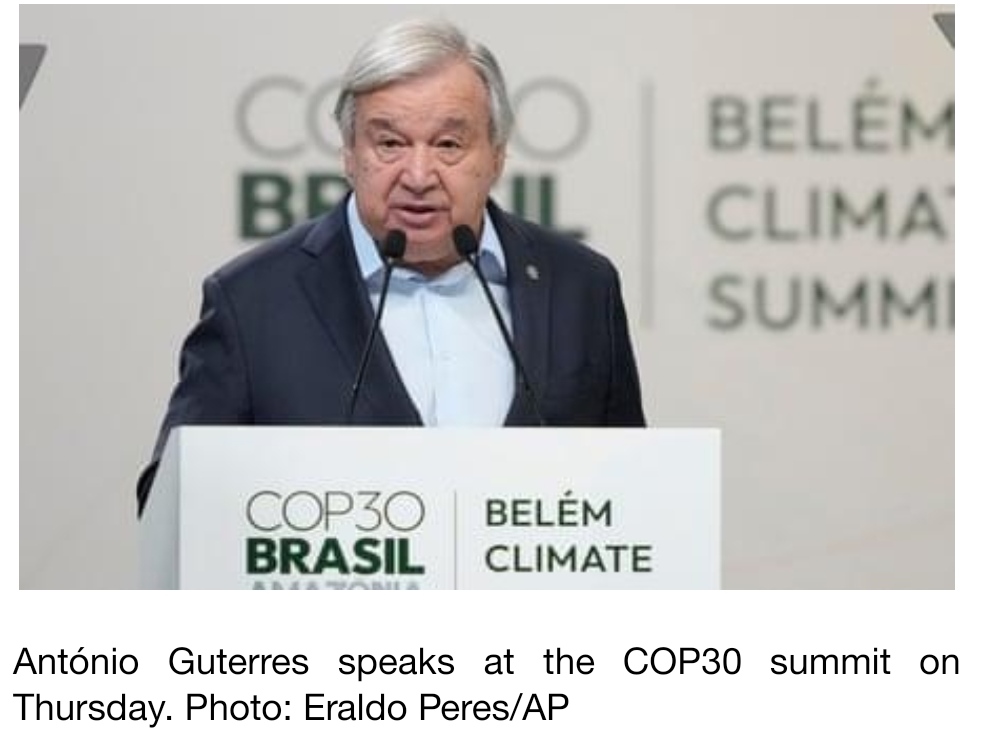
The summit’s tone was set before the first gavel fell, with UN Secretary-General António Guterres delivering one of the most blistering opening addresses in COP history. Calling the 1.5°C global heating limit a “red line” for a habitable planet, Guterres framed the world’s failure to meet it in starkly moral terms.
“Every fraction of a degree means more hunger, displacement and loss especially for those least responsible. This is moral failure – and deadly negligence,” he declared to heads of state.
Guterres’s urgency was grounded in fresh data from the World Meteorological Organization, which confirmed on Thursday that greenhouse gas emissions had hit a record high. The WMO projected 2025 would be the second or third warmest year ever recorded, capping off a decade that contained all 10 of the hottest years in measured history.
While Guterres acknowledged progress, current emissions plans, if implemented, put the world on a ~2.3 °C pathway, far better than the 5 °C doomsday scenario of 20 years ago. He savaged the forces holding back change and launched his “fiercest criticism yet” at the fossil fuel industry, stating, “Too many corporations are making record profits from climate devastation, with billions spent on lobbying, deceiving the public and obstructing progress.”
This sentiment was echoed by a chorus of leaders. Host President Lula, in his opening remarks, reinforced his “Cop of truth” theme, warning that the current 2.5°C path would still kill 250,000 people annually and shrink global GDP by 30%. He argued there could be “no solution for the climate crisis without tackling inequality” and urged leaders to be inspired by the Yanomami belief that forest peoples “are helping to hold up the sky.”
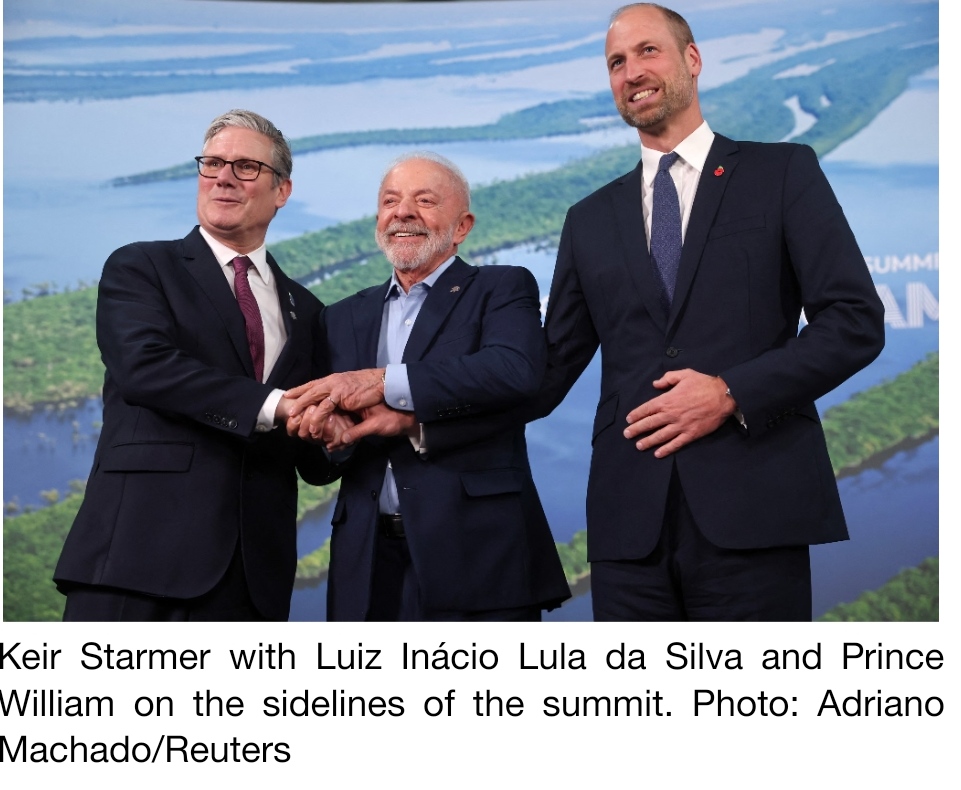
Other Western leaders joined the call. UK Prime Minister Keir Starmer insisted his country was “all in,” framing climate action as a “win-win” that would reduce bills and create jobs. He lamented that the “cross-party consensus” on climate in the UK was “gone.”
In a notable subplot, both Starmer and former US Vice President Al Gore took aim at prominent figures, including Bill Gates and Tony Blair, who have recently suggested a slowdown in climate mitigation. Gore, in a separate event, presented a “slide show of horrors” detailing recent climate-worsened disasters. “It is literally insane that we are allowing this to continue,” he thundered, calling out the “erstwhile climate advocate” (Gates) who suggested “dialing down” mitigation.
Day 2. The Elephant Not in the Room: America’s ‘Jaw-Dropping’ Absence.
While leaders decried moral failures, the world’s largest historical emitter and foremost economic power was, for the first time in the history of the COP, entirely absent. A Carbon Brief analysis confirmed the United States had not sent a single official delegate, placing it in the isolated company of Afghanistan, Myanmar, and San Marino.
The “Trump-shaped hole” left by the administration, one which has labelled climate change a “hoax” and “con job”, sucked the oxygen out of the proceedings. President Trump, who withdrew the US from the Paris Agreement earlier in the year, has reportedly spent months cajoling other nations to purchase US oil and gas.
The vacuum was met with a mix of fury, disappointment, and opportunistic resistance.
Furious Condemnation: Gustavo Petro, the president of Colombia, delivered the week’s most vitriolic attack. “Mr Trump is literally against humankind,” he stated. “We can see the collapse that will happen if the US does not decarbonize its economy. It is 100% wrong.” He blamed Trump and “petroleum industry lobbyists” for pushing the world from “climate crisis” to “climate collapse.”
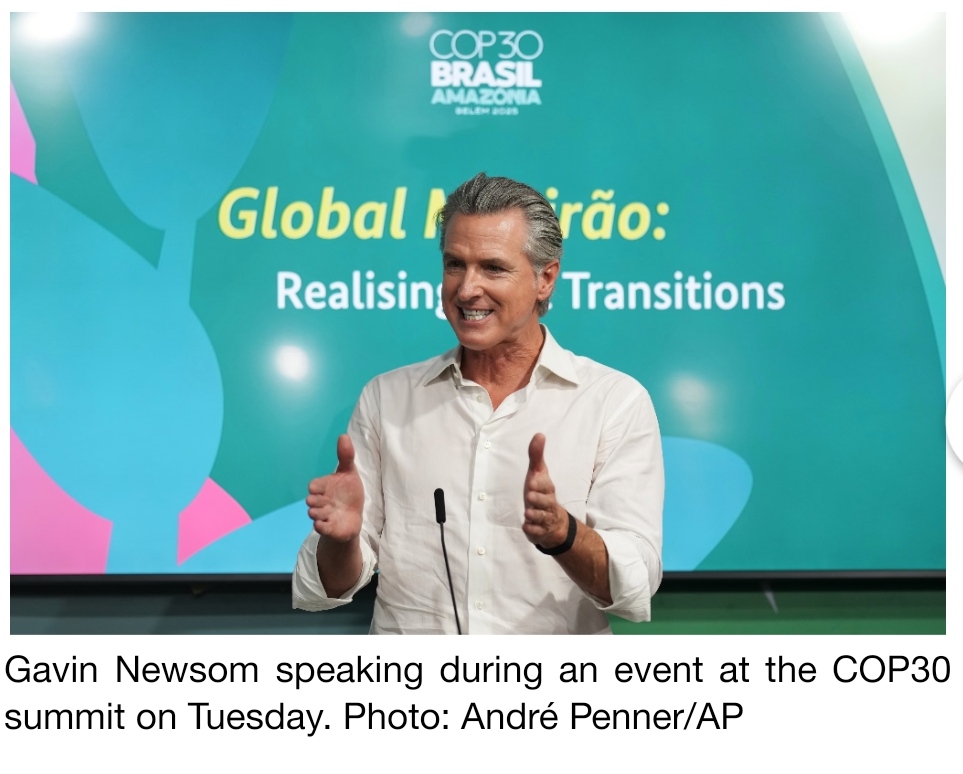
Sub-national Defiance: California Governor Gavin Newsom arrived in Belém with a clear message. “The reason I’m here is in the absence of leadership coming from the United States,” Newsom said at a side event. “This vacuum, it’s rather jaw-dropping.” Touting his state as the world’s fourth-largest economy, he positioned California as a “reliable partner” on green policy for the 195 other governments present.
Diplomatic Jabs: Other global powers made their displeasure known. Ding Xuexiang, a vice-premier of China, made a thinly veiled reference to Trump’s tariffs, stating that the green transition depends on a “free flow of green technology” and the removal of trade barriers. Christiana Figueres, an architect of the 2015 Paris agreement, was more blunt, comparing the Trump administration to “toddlers” and declaring the US had “lost credibility” on the world stage.
The US absence not only hampered progress but reinforced what Guterres called a broader “attack on efforts to build international collaboration.”
Day 3. Inside the Halls: ‘Love Letters’ and ‘Therapy’ to Break the Gridlock
While the political rhetoric dominated the headlines, the technical negotiations within the conference halls stalled.
The week began with a small victory: the formal agenda was adopted on Monday without the “agenda fights” that have plagued previous COPs. However, this was a procedural sleight of hand. The Brazilian presidency had convinced negotiators to “hive off” the four most contentious issues the “Big Four” into separate “presidency consultations” to be dealt with later.
These “Big Four” issues are the entire ballgame:
- Climate Finance (NCQG): How to fund the New Collective Quantified Goal, the $1.3tn-a-year promised at COP29. Developing countries are furious, seeing no clear path to this money and no accountability for developed nations.
- Trade: How to navigate the “green trade” barriers (like tariffs) being erected by nations like the US and some in the EU, which developing nations see as punitive.
- Transparency: How to uniformly report emissions and progress.
- NDC Adequacy: How to deal with the fact that the sum of all national climate plans (NDCs) is still not enough to meet the 1.5°C goal.
A core fear emerged that the key success of COP28—the “transition away from fossil fuels”—could be demoted from the formal, consensus-based agenda to Brazil’s new “action agenda,” a track that does not require consensus and is less binding.
By Wednesday, the paralysis was obvious. The presidency’s open plenary “stocktake” lasted a mere three minutes before being postponed. With the “Big Four” hopelessly snarled, COP30 President Andre Correa do Lago unveiled a novel, if not bizarre, strategy on Friday.
In an attempt to unstick the talks, do Lago invited delegates to “therapy.” The consultations, he insisted, were a “safe space” where parties could “talk freely of their feelings” about the issues. He then asked delegations to send him “love letters”—confidential missives where they could frankly express their fears, hopes, and true feelings. It was a radical, touchy-feely departure from the hard-nosed world of climate diplomacy, and a clear sign of a presidency desperate to break an impasse.
Day 4. The ‘Inside-Outside’ Conflict: Protests, Police, and the ‘Amazon COP’
The most potent and symbolic conflict of the week, however, took place not in the negotiating rooms but at the venue’s security gates.
This was intended to be the “Amazon COP,” a summit to “celebrate” Indigenous people, in the words of COP30 CEO Ana Toni. She boasted that it was the “most inclusive UN climate summit ever,” with 900 Indigenous representatives accredited. The Indigenous communities themselves told a different story.
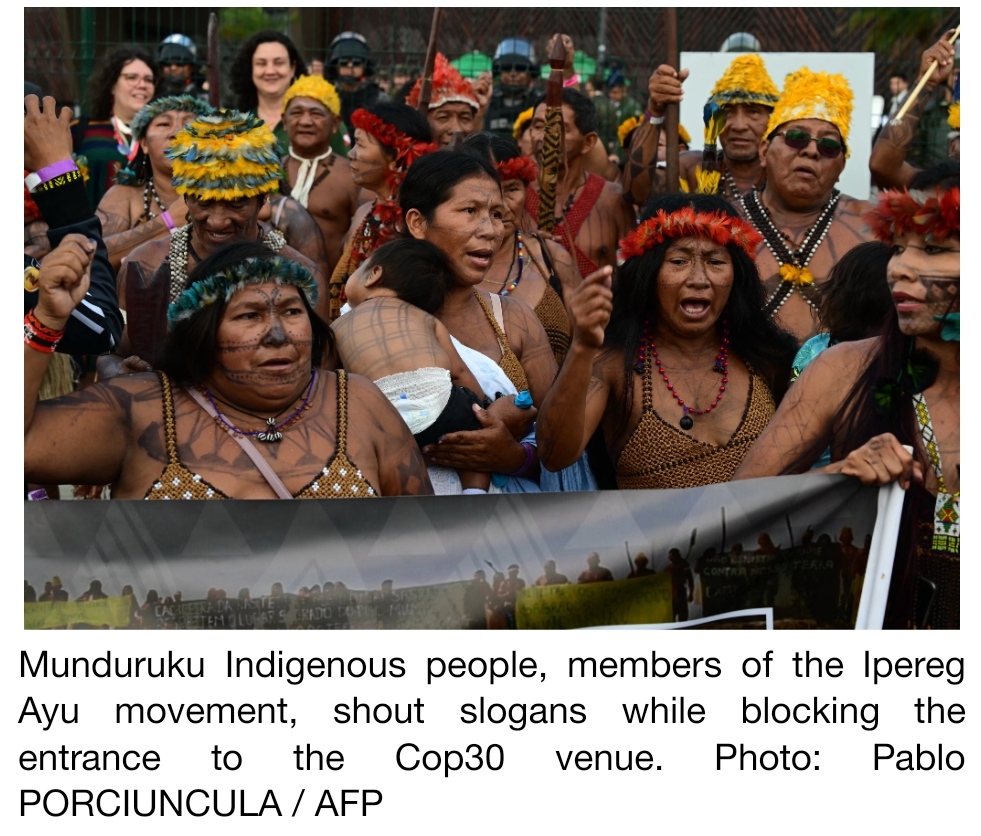
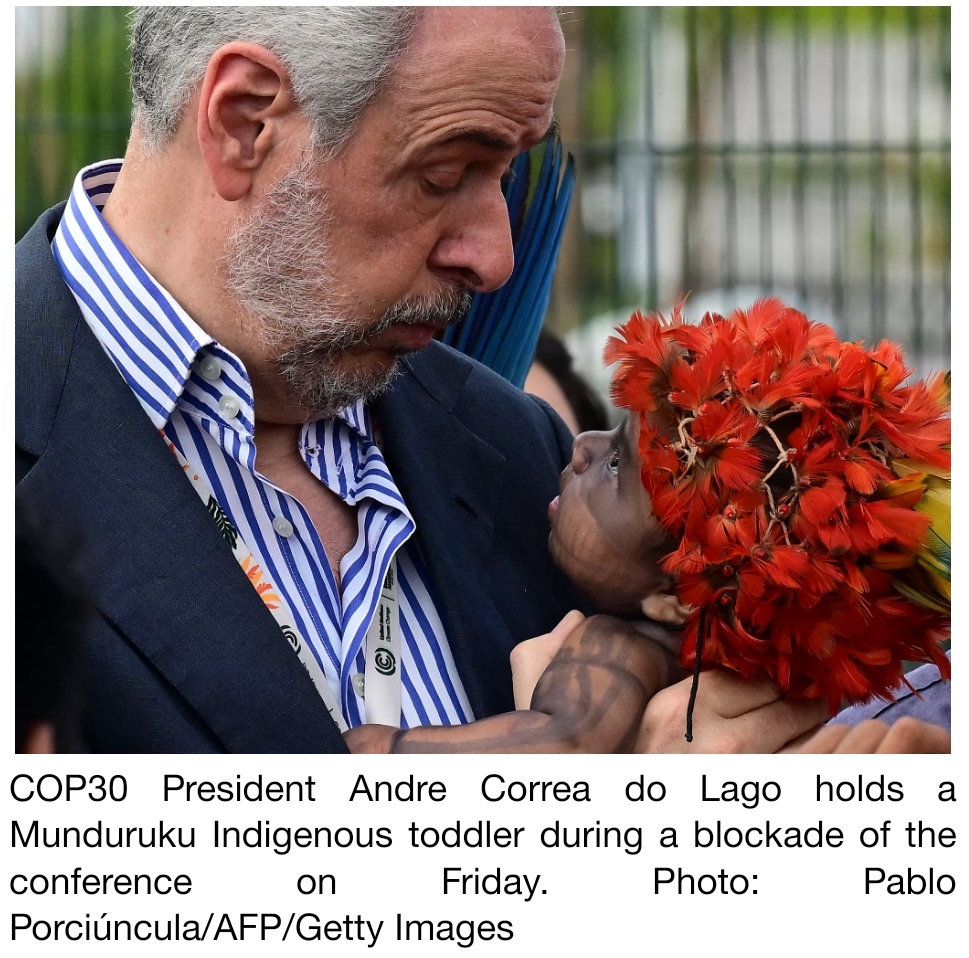
A “climate justice flotilla” of over 100 boats carrying 5,000 activists arrived for the “People’s Summit.” Protesters forced their way through security barriers, tussling with guards. A group of around 50 protesters from the Munduruku community, an Indigenous people in the Amazon basin, blockaded the entrance for hours. They were protesting not only the COP process but also national policies, including plans to privatize rivers in their territory. “We were always barred, we were never listened to,” one community member said. “Every type of venture is being invested in without listening to us.”
The standoff produced the “abiding image” of the week: COP30 President Andre Correa do Lago, coming out to meet the protesters and being photographed holding a Munduruku toddler amid a tense crowd.
Day 5. The Two-Front War
The week’s final theme was the battle against the entrenched forces of the old economy, specifically the fossil fuel lobby and the disinformation it disseminates.
- The Lobby: New analysis confirmed that 1 in every 25 delegates at COP30 is a fossil fuel lobbyist. This was compounded by a Transparency International report released on Thursday, which warned that more than half of all delegates had withheld or obscured their affiliations, allowing lobbyists to operate in the shadows.
- The Disinformation: For the first time, “information integrity” was on the formal agenda. On Wednesday, 12 countries (including Brazil, Canada, France, and Germany) signed the first-ever Declaration on Information Integrity on Climate Change. The move was a response to a 267% spike in COP-related disinformation and a new ClientEarth report showing how social media platforms amplify it. As one expert put it, the summit was finally addressing the “denial of the denial.”
Amid the gloom, there were flickers of progress. Brazil unveiled its flagship “Tropical Forest Forever Facility,” securing a $3 billion commitment from Norway. A “first global agreement” to strengthen land tenure for Indigenous communities, covering 160 million hectares, was announced. And the IEA’s 2025 World Energy Outlook confirmed that, despite Trump, the world is on track to hit “Peak Oil” by 2030, thanks to an unprecedented boom in renewables.
As the first week drew to a close, delegates were left in a state of cognitive dissonance. Leaders were demanding a paradigm shift, while negotiators were stuck in a state of “therapy.” A COP celebrating the Amazon was being guarded by armed police, and the official US chairs remained conspicuously empty. The “Cop of Truth” now has one week left to decide which truth it will tell: one of progress, or one of “moral failure and deadly negligence.”