

As multilateralism frays, the IPPDR’s Manhattan program trades diplomatic niceties for strategic simulation. The global system is showing cracks. War in Europe, economic decoupling, and a deep erosion of trust between major powers have turned the once-stable architecture of international cooperation into a high-stakes pressure cooker. The urgent question, according to a new wave of diplomatic thinkers, is no longer if global leadership must evolve, but whether it can evolve fast enough.
In mid-March, a select group of professionals gathered in Manhattan to test an answer. Over three days—March 17 to 19—the Institute of Public Policy and Diplomacy Research (IPPDR) convened its International Peace Practitioner and Global Peace Ambassadors Training. The setting was a structured, high-level environment. The goal was anything but academic.
More Than a Workshop: A Controlled Simulation
On the surface, it looked like a training program. In practice, participants describe it as something far more deliberate: a controlled simulation of the global system itself.
The timing was no accident. Energy corridors are being weaponized. Frozen conflicts are thawing and reshaping alliances. Economic shocks—from currency volatility to supply chain fractures—ripple across continents faster than diplomats can convene. For African nations in particular, these pressures are visceral: fuel price spikes, food shortages, and rising domestic unrest.
IPPDR’s core thesis is blunt. The world does not simply need better policies or more treaties. It needs better practitioners. People who can negotiate under fire, read informal channels as fluently as formal ones, and execute strategy without losing clarity.
Day One: Diplomacy as Structured Influence
The opening session, led by IPPDR Executive Director H.E. Ambassador Dr. Andrise Bass, reframed diplomacy entirely. It is not, participants were told, a ceremonial art. It is structured influence.
The discussion moved quickly beyond theory into the mechanics of statecraft:
· How to project power without triggering escalation.
· How to negotiate from a position of leverage asymmetry.
· How to use narrative as a tool to shape diplomatic outcomes.
For attendees from Africa and the Global South, this framing carried particular weight. It directly challenged a long-standing imbalance: the tendency for emerging economies to engage in global forums without controlling the narrative or the rules of engagement. The message was clear: agency must be reclaimed.
Day Two: When Security Becomes Human
If day one focused on the state, day two shifted to the individual. A targeted session on human trafficking, led by Mr. Richard Stephien, Supervisory Special Agent with Homeland Security Investigations (HSI), brought security down to its most urgent, tangible level.
The choice of topic was deliberate. Modern threats no longer respect borders or fit neatly into traditional conflict categories. Human trafficking is embedded in social systems, digital networks, and shadow economies that span the globe. For peace practitioners, understanding how to dismantle these networks is no longer optional—it is central to human security.
What Emerges: A New Type of Diplomat
By the end of the three days, a clear profile had emerged of the practitioner IPPDR is trying to build: strategically literate, operationally agile, and grounded in both high-level statecraft and grassroots human security.
The training did not promise easy answers to the world’s fractures. But it offered something arguably more valuable: a method. A way to think, negotiate, and act when the old rules no longer apply. As one participant noted, “We came for the theory. We left with a toolkit.”
In a world where trust is scarce and crises are constant, that toolkit may be the most valuable asset a peacemaker can carry.
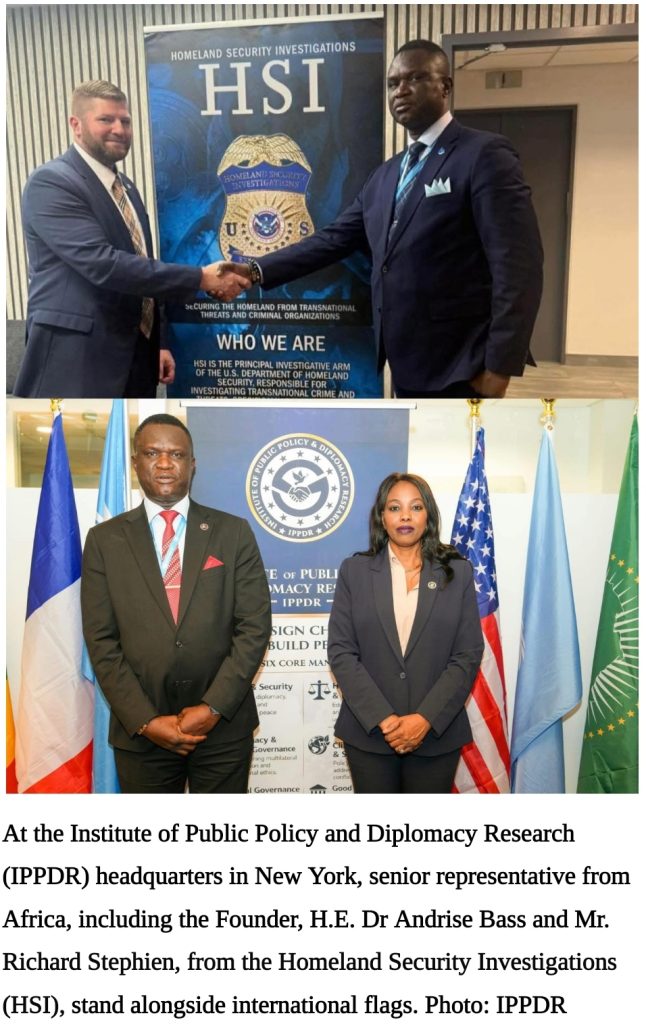
Beyond Theory: Inside the High-Stakes Training Shaping a New Breed of Peacemakers. From the classroom to the UN floor, a simulation tests the limits of modern diplomacy.
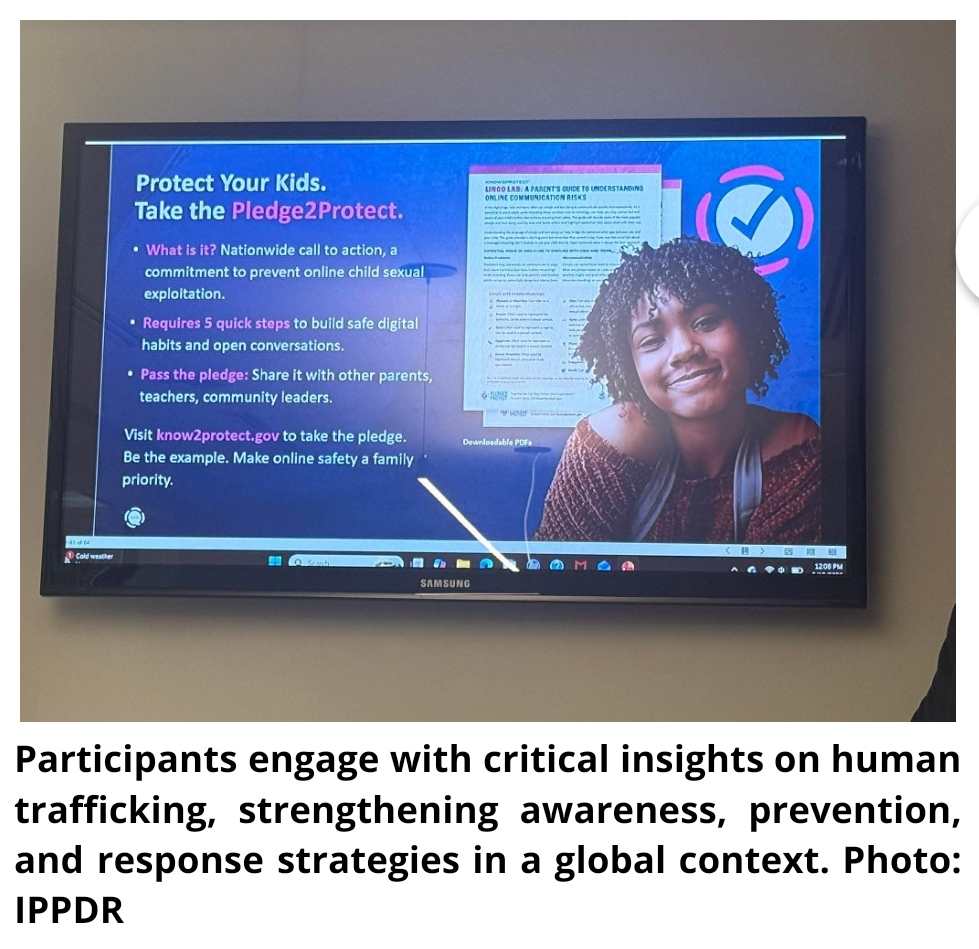
The second day of IPPDR’s International Peace Practitioner and Global Peace Ambassadors Training took a sharp turn from high-level statecraft to one of the darkest realities of the modern world. Participants engaged with the mechanics of trafficking networks, legal frameworks for response, and prevention strategies, guided by Mr. Richard Stephien, Supervisory Special Agent with Homeland Security Investigations (HSI).
More importantly, they examined the policy gaps that allow such systems to persist. For African countries, where trafficking intersects with migration, economic vulnerability, and governance challenges, this issue is not peripheral; it is central to national and regional stability.
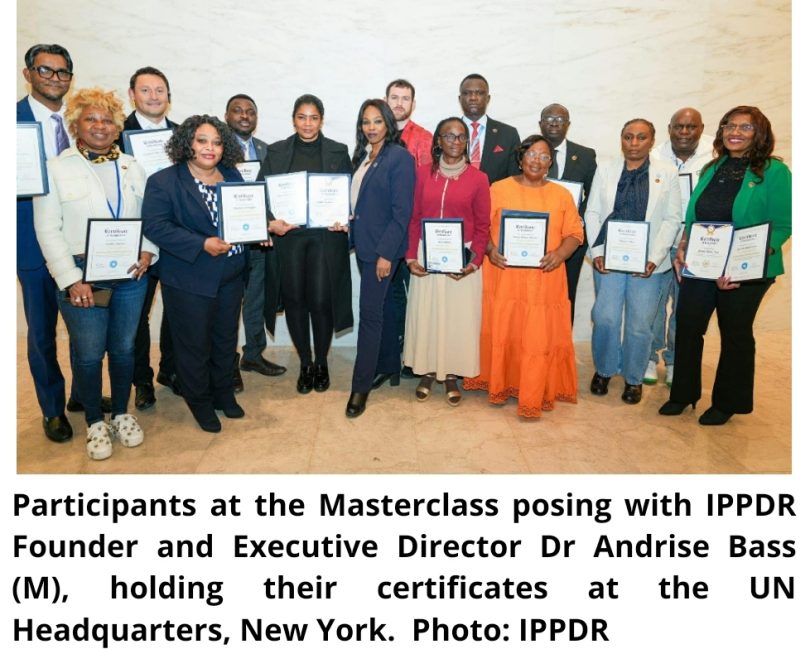
Later that day, the tone shifted from gravity to recognition. Participants transitioned from the classroom to a diplomatic setting at the United Nations Headquarters Delegates Dining Room, where certification ceremonies were held. Surrounded by the symbols of multilateralism, they received formal acknowledgment of their commitment to a new kind of peace practice.
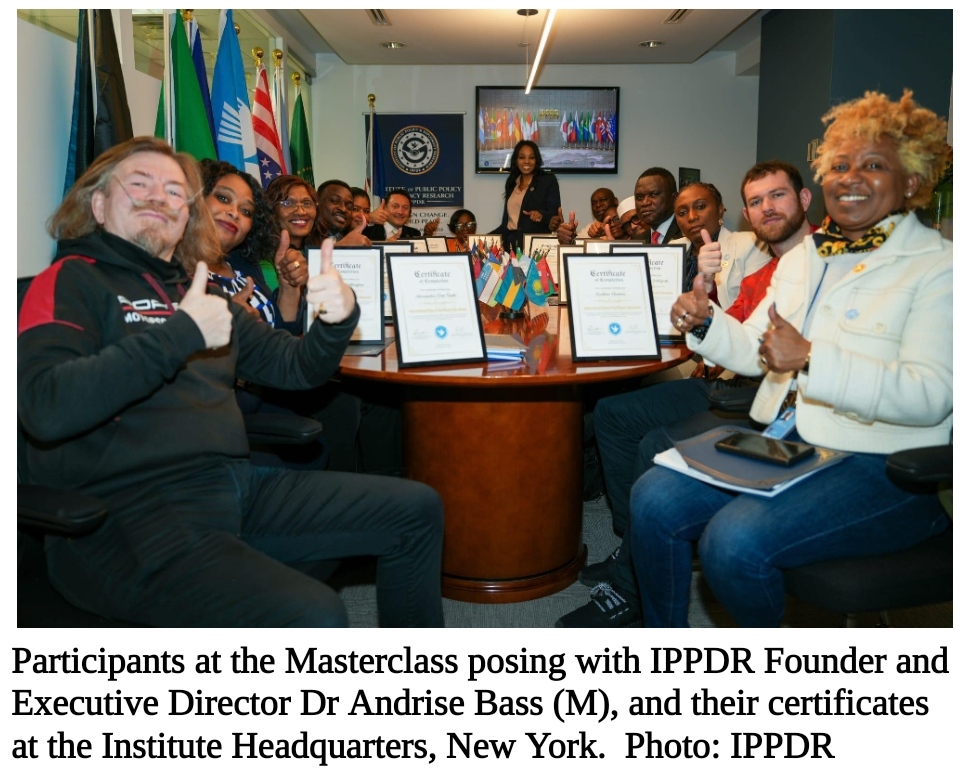
Day Three: A Simulation That Mirrors Reality
The final day of the training moved into its most practical and intensive phase: conflict prevention, negotiation, and peacebuilding. Here, the structure shifted from instruction to simulation.
Participants were assigned roles within a high-stakes geopolitical scenario centered on tensions between the United States and Iran, with a focus on the Strait of Hormuz and global energy security. This is a scenario with real-world consequences. Roughly 20 percent of the global oil supply moves through that corridor, meaning any disruption would have immediate ripple effects across economies, particularly in energy-dependent regions such as Africa.
Within the simulation, participants were tasked with navigating competing interests:
· Security concerns versus economic survival
· Sovereignty versus international oversight
· Historical distrust versus future cooperation
What emerged was not a scripted resolution, but a process. Delegates debated sanctions, nuclear policy, humanitarian concerns, and maritime security. They negotiated under pressure, managed competing narratives, and worked to build consensus in an environment of limited trust.
This reflects the reality of modern diplomacy and highlights a critical gap: most leaders are never formally trained—like IPPDR’s Peace Practitioner and Global Peace Ambassadors—to operate in such conditions.
The African Dimension: Why This Matters More Than It Appears
Among the 16 participants were representatives from Senegal, Ghana, Côte d’Ivoire, Benin, and Chad, alongside peers from the United States, Haiti, Argentina, Ukraine, Russia, Trinidad and Tobago, Jamaica, Guyana, and others. Their professional backgrounds were equally varied, ranging from government advisers and lawyers to religious leaders, public figures, and former diplomats.
For Africa, this diversity is not incidental. It reflects the multidimensional nature of governance across the continent, where political, social, and cultural actors often intersect in shaping outcomes. But the deeper significance lies in exposure.
African participants are not only learning frameworks. They are engaging within a global context, building networks, and gaining insight into how decisions are shaped at the highest levels. In diplomacy, proximity matters. So does participation. In many cases, Africa has been underrepresented in both. Programs like this are beginning to shift that dynamic.
What Comes Next
As the three-day training concluded, one thing became clear: the gap between crisis and response cannot be closed by institutions alone. It requires individuals—trained, agile, and connected—who can step into fractured rooms and build bridges where none exist.
For the 16 graduates who walked out of that Manhattan training center, the real test has only just begun. The world they are stepping into is not a simulation. But thanks to three intense days of strategic immersion, they may be better prepared than most to navigate it.
Here is the final part of the article, based on the text you provided.
From negative peace to structural stability—how a Manhattan training program is preparing Africa’s next generation of diplomatic leaders.
One of the central concepts explored during the training is the distinction between negative and positive peace. Negative peace refers to the absence of violence. Positive peace reflects the presence of justice, inclusion, and functional institutions. It is a distinction with profound implications for Africa.
Many countries across the continent have achieved relative stability, but underlying structural issues remain: political exclusion, weak legal systems, and unequal resource distribution. These are not immediate crises, but they represent long-term risks. Without addressing them, negative peace can easily unravel into renewed conflict.
IPPDR’s framework encourages participants to identify these structural gaps and develop policy responses. Through its policy innovation modules, participants map weaknesses in security, justice, and inclusion, and propose reforms that are both realistic and scalable. The goal is not simply to stop wars, but to build systems where wars become less likely to start in the first place.
Youth, Power, and the Future of Diplomacy
Another critical dimension of the training is its focus on youth and inclusive leadership. Drawing on global frameworks such as UN Security Council Resolutions 1325 and 2250, the program positions youth and women not as beneficiaries of peace, but as architects of it.
For Africa, this is not theoretical. With one of the youngest populations in the world—over 60 percent of sub-Saharan Africa is under the age of 25—the continent’s stability and growth will depend heavily on how effectively it integrates youth into governance and decision-making processes. Excluding them is not merely unjust; it is strategically self-defeating.
Training programs that equip young leaders with diplomatic and policy skills are not just educational initiatives; they are strategic investments. Each participant who leaves IPPDR’s program carries not only knowledge but also a network, a methodology, and a mandate to apply those tools in their home contexts.
The Bottom Line
Within a room in New York, a carefully selected cohort moved through high-stakes simulations, rigorous negotiations, and strategically layered exercises that mirrored the pressures of real-world diplomacy. On the surface, it resembled training. In substance, it was a controlled rehearsal for complexity—a deliberate conditioning of judgment, restraint, and strategic clarity.
This is preparation for a global order in flux, where diplomacy is no longer linear, governance is increasingly contested, and the margin for error has narrowed significantly. The question posed at the beginning of this series—whether global leadership can evolve fast enough—remains open. But programs like IPPDR’s offer a provisional answer: yes, but only if we invest intentionally in the people who will wield that leadership.
For Africa, the implications are clear. The future of leadership is no longer shaped solely in presidential offices or at high-level summits. It is being forged in disciplined, high-intensity environments where ideas are stress-tested, assumptions are challenged, and capability is built with intention.
The architects of the continent’s next phase of growth will not simply emerge through position or rhetoric, but through preparedness—through individuals who have internalized global complexity and developed the competence to navigate it with precision, credibility, and resolve.
As the 16 graduates of this cohort return to their respective countries—from Senegal to Ukraine, from Ghana to Haiti—they carry more than a certificate. They carry a framework for action. And in a world that seems to lurch from crisis to crisis, that may be exactly what is needed.